Wednesday, 16 September 2009

Caterham and London

I have been staying at Jane and Ian's place for two and a half weeks. I have spent quite a lot of time with Ben and Zoe and I have dropped then off and picked them up from school quite a few times. I am getting to know some of the mums, but I cannot say that I am in with the in crowd just yet. Ben and Zoe are cute and energetic as always. Over time I have gotten to know their routines and limits so that plaintive cries of "Mummy said that we can!" or "Mummy lets us do it!" are now met with a little bit more scepticism.

My main goal on returning from Wales had been to sell my car. I sold the car to the first person who answered my advertisement, which was a lot easier than I had expected.

I have caught up with a few friends. Mark and I tripped around London looking at a few of the less "touristy" sights. One was Ely Place in Holborn. Ely Place is a cul-de-sac and is not technically part of London but is an enclave of Cambridgeshire. The reality appears to be less interesting, with a notice for the Borough of Camden attached to one of the lamp posts in Ely place. We had a pint at the "Old Cheshire Cheese" one of the oldest pubs in London. It has an atmospherically gloomy interior.


I had a great night out with Jessie, James, Celia, Graeme, Nikki and Olly last Friday. On Saturday they and James' (and Graeme's) parents visited Buckingham Palace. For budgetary reasons, and because lavish decoration does start to pale after a while, I skipped the Palace and joined them later at the Royal Academy of the Arts, to be meet by a very long queue for the exhibition. On Sunday I caught up with Caroline who cooked me a lovely meal.


I had lunch with Manuela yesterday in Marylebone. It was all very nice until we went to leave and realised that Manuela's handbag had been stolen! Luckily she did not have much of value in it. However, her house had been burgled on Monday, so she was not having a good week. Manuela's mobile phone was found today, but not her handbag. Yesterday evening I had a long chat with Ernie over a few pints.

Jame's recently commented that he thought my blog was perhaps not "personal" enough. I agree that my thoughts and feelings are rarely expressed other than in a cursory manner. However, on the whole, I think that this blog is remarkably open, at least for me. Should I reveal more? Well, as OMC said, "Wanna know the rest? Hey, buy the rights..."

Tuesday, 1 September 2009

Wales

I spent four nice days with Jane, Ian and the kids after returning from Europe. On Wednesday I drove to Snowdonia in Wales. I was caught in a massive traffic jam on the M25 for two hours trying to leave London, but it cleared just before I was about to give up and go home. I camped for three nights in Snowdonia in a camping ground that was at least half mud. On Thursday night there was a big storm but my tent held up well. My goal in Wales was to do a few of the things that I had not had a chance to do when I visited last Easter. Top of my list was to climb Mt Snowdon, the highest mountain in Wales. The day was not great but the climb was relatively easy. It was very crowded at the top, with a lot of people having come up on the narrow gauge railway that goes to the top of Mt Snowdon (the "cheats" route). Climbing Mt Snowdon meant that I had climbed the highest peak in each of England, Wales and Scotland (as well as the highest peak in Ireland). Climbing those peaks was not exactly the same as climbing Mt Everest without oxygen but it has been fun. On top of Snowdon-

On Friday I went on the narrow gauge railway from Blaenau Ffestiniog to Porthmadog and back. The railway winds through a picturesqe route in the countryside. I also visited Portmeirion, a small Italianite village in Wales. It was built by an eccentric Englishman over 50 years from 1925. It is a place I have wanted to visit for a long time, as it was featured in the TV series "The Prisoner". I had watched repeats of "The Prisoner" in NZ in the 80s. Portmeirion village-

On Saturday morning I went on a tramp to Molwyn Bach, a "mountain" near Blaenau Ffestiniog I had visited last year, when it was covered in snow. So it was interesting to see it in the "summer" (top temperature about 18C with intermittent showers). On Saturday afternoon I drove to Liverpool, because it was relatively close and because I was curious about it. On the way I stopped on Bounday Road in Chester. As the picture shows it looks like an ordinary suburban street. Except that the houses on the left hand side are in England and those on the right are in Wales. It is the only urban area on the English/Welsh border where this happens (and as far as I am aware there is no equivalent place on the English/Scottish border). It would be fascinating to learn more about the place. For example, do people on the English side have English accents and those on the Welsh side Welsh accents? I could have knocked on a few doors to find out but I do not think that they would have welcomed my interest.

I cannot say that Liverpool is the nicest city I have visited but it was pleasant enough and the Scousers add atmosphere. On Sunday night I stayed with Nikki and Olly in Chippenham. Nikki's friend Jordan (a NZ guy) also stayed. On Sunday we visited Avebury (more standing stones) and the White Horse of Uffington (my third visit but still one of my favourite spots in England). I drove back to London in the afternoon with Jordan, who needed to catch a train from London.

Travelling to Wales completed the itinerary I had put together in April for my travels with my car. So my next goal is to sell the Focus and to then prepare for my trip to Thailand and my return to NZ.

Monday, 24 August 2009

Belgium

I spent my first night in Belgium in Antwerp. Scandalously, I did not sight see in Antwerp (or buy a diamond). My main goal in northern Belgium was to visit the town of Baarle-Nassau/Baarle-Hertog. Baarle-Hertog is a Belgium enclave within the southern part of the Netherlands. The Belgium bits are not continuous, but are scattered around the town in sections. The result is that, as you walk down the main street, you cross the border of Belgium and the Netherlands several times. Border markers on the main street-


The Dutch part of town is called Baarle-Nassau. A map helps to make a little more sense of what I am talking about-


There are border markers in some parts of town. Otherwise, the most obvious sign that you have crossed the border is that the number plates on the cars change. The locals have taken advantage of the situation. For example, there are several shops selling fireworks in the Belgium parts of town- the sale of fireworks is more strictly controlled in the Netherlands. And in the Dutch parts of town there are several brothels, for corresponding reasons. Me in front of the house with two buildings numbers (because the border passes through the front door!)-


I spent two nights in Bruges. Bruges is another place that had a golden era followed by hundreds of years of relative poverty, in Bruges's case because the canal leading to the the city silted up. So the city was preserved and is now home to many many Australian backpackers. Bruges is lovely-


The city of Ypres is about an hour's drive from Bruges (nowhere is very far from anywhere else in Belgium) and is another war themed destination, this time in relation to World War 1. Ypres was on the western front throughout the war and was completely destroyed. The battle of Passchendaele was fought nearby. I visited the very good In Flanders Fields museum, which has exhibits relating to the various battles for Ypres and the horrors of the war generally. Ypres was rebuilt after the war. The older buildings are exact replicas of the pre-war buildings. I visited the nearby "Yorkshire trench", which was excavated about 10 years ago. The trench system has been partly recreated. It is in the middle of an industrial estate-


On Saturday I took the ferry from Calais to Dover. I had a fantastic six weeks in continental Europe.

Germany

I spent a few days in Germany on my way back to the UK. I started in Dresden, a relatively short drive from Poland. Accommodation was hard to find and I ended up staying at a camping ground. If I had done a little research I would have discovered that it was the weekend of Dresden's annual festival. So I was quite lucky, as there were many free concerts and a carnival atmosphere. Although Dresden was in the former East Germany it does not look like a typical "Soviet block" city, with some exceptions-


Dresden is famous for its Baroque buildings. But it is most well known because of the destruction of the city and those buildings by Allied bombing during World War 2. The centre of the city has largely been rebuilt and it now looks much like it did before the war. I went on an excellent tour of the buildings. The guide showed photos of the burnt-out buildings taken after the bombing, to contrast the now perfectly reconstructed buildings. This view shows the Elbe river and the dome of Frauenkirche, a church that was destroyed in the bombing and which only reopened in 2005.


From Dresden I went to Rothenburg. Rothenburg had been a very prosperous town but it then fell on hard times. The happy result was that its medieval buildings were preserved. It is now a hugely popular tourist destination.


My final stop in Germany was in Karlsruhe. Karlsruhe is a very nice city and home to the German Supreme Court. But my reason for going to Karlsruhe was to visit my friend Linda. Linda and her mother Liliana were very hospitable and Liliana made very nice Croatian meals. Linda took me on tours of Karlsruhe, including her neighbourhood and the botanical gardens, as well as of nearby Ettlingen. We also went to Bad Herrenalb, a town on the northern edge of the Black Forest. We went for a pleasant walk in the Black Forest. Liliana, Me and Linda-

It was then goodbye to the autobahn and on to Belgium.

Thursday, 20 August 2009

Poland

My first stop in Poland was Krakow. It was quite strange visiting Poland. It is one of those places that seemed very distant and "exotic". Krakow is the most popular tourist destination in Poland. Unlike many other Polish cities Krakow escaped destruction in World War 2 and is now a World Heritage Site. Krakow was the seat of Polish royalty for hundreds of years. I visited the Cathedral, which contains the tombs of royalty dating back hundreds of years. The central square of Krakow is huge and contains many spectacular buildings:

Not far from Krakow is Auschwitz/Birkenou, the complex of Nazi death camps. I spent the afternoon on a tour of the sites, which still contain many of the original buildings. It was very sobering seeing for real a place that I had only before seen in documentaries and movies. It is hard to comprehend that more than a million Jews were killed in that one area. But seeing the sites brought home to me that those events really happened, that the perpetrators and victims were real people and that the Holocaust really only happened relatively recently.

From Krakow I travelled to Wroclaw, a pleasant city with many Gothic and Baroque buildings. I had a day off in Wroclaw and took it easy. From Wroclaw it was a relatively short drive to Germany and the end of my travels in eastern Europe.

Monday, 10 August 2009

Slovakia

I eventually made it to Slovakia, after returning to Croatia to pick up my clothes. My goal was the "High Tatras" in northern Slovakia. Because of the delays caused by my own forgetfulness, I did not make it all the way to the Tatras on the first day. Instead I stopped in the city of Lucenec, only because it was a useful stopping off point. I stayed in a two star hotel, which was quite luxurious compared to camping and staying in hostels. The lift had an exterior door but no interior door, so I could see the exterior doors passing as I went up. I have never seen a lift like that before, except in my nightmares. I only used it once and after that walked to the 4th floor. In the morning I drove to the High Tatras. The Tatra mountains are the biggest mountain range in central Europe and the highest part is in Slovakia. The highest peeks are a bit over 2600m although they do not seem that high from a distance as the elevation is already about 900m. I camped but did not rough it, as the food in the camp restaurant was good and was very cheep. The High Tatras from the camp:

I spent two days walking in the Tatras. On each day I walked up to around 2000m. At that height it was pleasantly cool and the views were great. It is possible to take a cable car to one of the highest peeks, Lomnicky stit. There are no itermediate pylons holding the cable, simply one very long cable which takes the cable car from about 1600m to over 2600m. It looks incredible and absolutely terrifying. The chicken in me came out again and I did not use it. It was great getting out and about in the outdoors and getting some exercise.

Before leaving Slovakia I went to the Dobsinska ice cave, which is a world heritage site and, as the name suggets, a large cave filled with ice. Visitors are taken through in large groups with a guide. Unforunately the guide only gave his commentary in Slovak. However, the cave was amazing.

Thursday, 6 August 2009

Dubrovnik, Montenegro, Bosnia & Herzegovina, Podgora, Zagreb, Osijek

Dubrovnik is always a nice place to visit, if for no other reason than to swim in the amazingly clear (if a little chilly) waters.
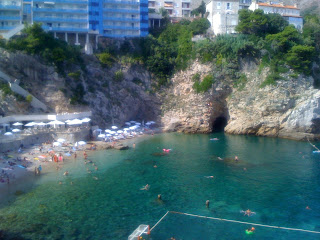
It was very hot while I was there, so going for a swim was a must. I visited Srd, the hill behind Dubrovnik, where there is an old fort. In the fort there is an interesting exhibition on the Serb attack on Dubrovnik and surrounding areas and their unsucessful attempt to take Srd, which was the key to their plan to take Dubrovnik.

A couple of hours from Dubrovnik is Prevlaka Peninsula, which is at the very south-eatern tip of Croatia. It is a a key strategic point as it guards the entry to Montenegro's Bay of Kotor. Prevlaka was administered by the UN after Serbian forces withdrew and was only returned to Croatia in 2002. It is now a park. It had the scariest spiders I have ever seen- their webs were strung between trees at least 3 metres apart and the spiders themselves were enormous. The most interesting part of Prevlaka was exploring the many abandoned army buildings.

From Dubrovnik I drove to Lake Skadar, in Montenegro. It is a large lake and is partly shared with Albania. It is continuously refreshed from springs at the bottom of the lake.
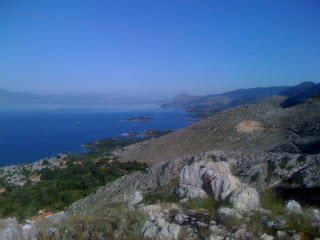
Driving in Montenegro is fairly terrifying. The roads are bad and drivers love to overtake on blind corners.

From Montenegro I drove back to Croatia and then to Mostar in Bosnia. Mostar is and was famous for the old bridge which linked the Muslim east bank of the Neretva river with the majority croatian populated west bank. The bridge was destroyed by Croatian forces during the war. When I visited in 1996 the Muslim areas were largely rubble and a small rope bridge had been put in place of the old bridge. The Croatian areas were intact. It was a very disturbing place to visit- at that time I did not feel comfortable taking photos, so I didn't. There was far more traffic on the roads when I visited this time (in 1996 UN APCs were a common sight), the old bridge has been rebuilt and the old Muslim section rebuilt. It was nice seeing the old part of Mostar as it had looked before the war. However, many of the other bullet-ridden and bomb scarred shells of buildings are still there, I guess because no one can afford to demolish them. From Mostar I went to Sarajevo, a city I could not bring myself to visit in 1996. There are visible scars from the war but it is also obvious that much of the damage has been repaired. I did a very interesting tour to the tunnel which was the only land route into Sarajevo during the Serbian seige. It was interesting that in both Mostar and Sarajevo most women were dressed in a way that was indistinguishable from Croatian women. Head coverings were rare and I did not see any women wearing the burka. The language spoken by Bosnian Muslims is very similar to Croatian, but is called "Bosnian". I won't go into the politics of language here.

From Bosnia I headed back to Podgora and spent a pleasant few hours with Niksa and Ana. I then set off for Zagreb. I spent the weekend in Zagreb with Nena. We visited her nice bach in the country by the Kupa river. Nena's friend Goranka fed me very well and Goranka's son Ivan was his usual rambunctious self.

From Zagreb I went to Osijek, a city in the northeast of Croatia. That part of Croatia is largely flat and is a significant agricultural area. Osijek was nice if not terribly exciting. I visited Vukovar, a city to the east of Osijek, and nearby Ovcara. At Ovcara there is a memorial to civilians and soldiers from the Vukovar hospital who were massacred and buried at Ovcara by the Yugoslav army and serbian irregular forces after they overran Vukovar.

I set off from Osijek to Slovakia on Wednesday morning. I experienced my first rain in three weeks. Over an hour into the journey and just after crossing the Hungarian border I realised that I had left a bag to dirty clothes at the hostel in Osijek. So I headed back to Osijek and back through the Hungarian and Croatian border posts. I picked up three Polish backpakers at the Croatian border post. They were trying to get to Osijek. It was a bit of a squeeze but I felt sorry for there as it was a public holiday in Croatia so there were no cars heading to Osijek from Hungary. They were lucky that I am so forgetful. I retrieved my clothes from the hostel and headed north again.

Friday, 24 July 2009

Nick Papa- 18.03.1940 - 24.07.2009


Uncle Steve, Nana, Me, Dad and Uncle Nick, March 2009

Uncle Nick worked 363 and a half days a year. He closed his shop on Christmas Day and on ANZAC Day morning. Uncle Nick was always there. As children we would make play houses from his road signs and wooden fruit boxes. We would go into the orchard with Uncle Nick when he picked fruit. When we were older he allowed us to serve customers in the shop. We loved using the till and the electronic scales. Uncle Nick patiently taught us how to use them. Uncle Nick never displayed his emotions openly, but that really did not matter. And sometimes you could tell what he was thinking even if he did not say anything.

Uncle Nick gave a speech at his 40th birthday party. He said that now he was 40 he would have to start slowing down. That was his understated sense of humour. I thought that he was being serious- when you are 8 years old 40 does seem pretty old. Uncle Nick always knew what was going on in Kumeu and Huapai, often from his customers. If he knew something that was likely to interest you he would not just tell you straight off. He would hint at it and try to get you to guess what it was about, just to the point where you started to get a little annoyed.

Uncle Nick went to the markets early in the morning every Monday and Thursday. We would occasionally go with him, getting up at what seemed to us to be an unbelievably early hour. It was surprising to see Uncle Nick in a completely different world, a world where he seemed completely at home. It was amazing to watch him deal with ease with an auction process that to us was almost impossible to follow.

He loved to tell us where he was when significant events happened. He told us that he was in the orchard picking fruit when when the news came through that President Kennedy had been assassinated. He was proud of the fact that he remembered seeing American soldiers in a military jeep when they were stationed in NZ during Word War 2.

After selling part of his property in 1997 he went on what was only his second trip overseas. Although he said that his trip to Australia did not really count anyway as in 1973 you did not have to take a passport. He visited Croatia and the United States, two places that he had really wanted to visit. One of my great pleasures in life was just being able to pop in on him and Nana, knowing that they would be there. I really enjoyed visiting them on a Friday or Saturday night and watching a game of rugby or rugby league with them. When I was there Uncle Nick would usually check the value of his shares on teletext. The shop was very successful in later years. He developed a reputation for selling white fleshed nectarines and peaches, which he moved in large quantities. He really did seem content and very happy with life. It is so hard to imagine that he will not be there any more.

Uncle Nick was an orchardist. Uncle Nick died from the effects of liver failure. Dad was with him when he died. We loved Uncle Nick and will miss him very much.

Wednesday, 22 July 2009

Podgora- Part 3

On Monday evening I had dinner out with Bepica, my grandfather's cousin. I then had a very pleasant chat with Bepica and his wife Ilonka on their balcony overlooking Podgora. On Tuesday morning I had morning tea with Lili, Lada and their friend Carmela. Niksa cooked a nice lunch and Mate, Nikolina, Marion and their families came for lunch. It was a relaxed afternoon. After lunch we spent some time in Vlado's courtyard (I am obliged to mention that Vlado feed us some very nice prsut) and then I went with a walk around the old village with Niksa and Marion, Niksa acting as tour guide. In the evening I watched "Naked Gun 3" with Niksa and Ana and Ana kindly did yet more of my washing. This morning I visited the cemetary and had a nice lunch with Vlado and Tatjana and the ubiquitous Huso. I had a very nice time in Podgora.
In the afternoon I drove to Dubrovnik. Dubrovnik and the surrounding region are completely separated from the rest of Croatia by Bosnia and Hercegovina, which extends all the way to the sea at the town of Neum. So a drive to Dubrovnik requires a drive through Bosnia and Hercegovina, which does not take long, as the coast is only about 10km long. The nuisance factor is that it is impossible to buy car insurance for Bosnia and Hercegovina in the UK, which means that the drive, while short, is completely uninsured. Of course nothing happened, but I could not help feeling a little nervous. I arrived in Dubrovnik at 6.30 and found accommodation without any problems. The weather continues to be sunny, with temperatures in the low 30s.

Podgora- Part 2

Later on Sunday afternoon Niksa took me to the park on the Biokovo mountain and to the summit of Biokovo. The drive was hard going for Niksa in a small car, without power steering and on a very narrow and steep road with many hairpin turns. The summit, Sveti Jure, is at approximately 1700m, so it was quite a drive. The views from Sveti Jure were amazing, especially as the air was very clear that day. In the evening I chatted to Ruzica, a cousin of my grandfather. Ana make a very nice meal of roast chicken and pasta, which she was concerned to discover was similar to the meal I had had for lunch at Tatjana and Vlado's. Of course I was not concerned at all. On Monday I joined Lada and Zoran for their daily visit to the beach with their children. I had lunch with Niksa and Ana, Niksa's children Mate and Nikolina, Nikolina's husband Marion and their children Lucija (3) and Patrick (a few months old). Mate's son Ivan (9) was there also. Lucija is lovely. Ivan can only be described as precocious- his English is already very good, even better than Vlado's. Lunch was very good and was courtesy of Marion. Mate and I in the yard of the "Papa house"-